
Your doctor has recommended a heart test and mentioned either a 2D echo or a TMT — or possibly both. If you are not sure what the difference is or why one is being recommended over the other, you are not alone. These are two of the most commonly prescribed cardiac investigations, and they look at the heart in completely different ways. Understanding what each test does makes it much easier to go in prepared and to understand what the results mean. As a leading heart specialist in Aurangabad, Dr. Kuldeep Totawar at Sonobeat Heart Care uses both tests regularly and this blog explains exactly what each one is looking for.
The short answer is that a 2D echo in Aurangabad looks at the structure and function of the heart at rest, while a TMT stress test in Aurangabad looks at how the heart performs under physical stress. They are complementary, not competing — and many patients need both. Find Sonobeat Heart Care on Google to book your cardiac evaluation.
Have heart concerns? Book An Appointmentat Sonobeat Heart Care today.
What Is a 2D Echocardiogram?
A 2D echocardiogram (2D echo) is an ultrasound of the heart. A small probe placed on the chest sends sound waves that bounce off the heart structures and create a real-time moving image on a screen. It is completely painless, takes about 20 to 30 minutes, and requires no radiation or injections.
Think of it as a live video of your heart in action. The cardiologist can see the heart chambers, the valves, the walls of the heart, and how strongly and evenly the heart is pumping — all in real time.
What a 2D Echo Is Looking For
• Heart size: Whether the chambers are enlarged, which can indicate heart failure or long-standing high blood pressure
• Pumping function: The ejection fraction — the percentage of blood pumped out with each beat — is one of the most important measures of heart health. A normal ejection fraction is 55 to 70 percent
• Wall motion: Whether all parts of the heart wall are moving equally. Areas that move weakly or not at all may indicate a previous heart attack or reduced blood supply
• Valve function: Whether the heart valves are opening and closing properly. Valve narrowing (stenosis) and leakage (regurgitation) are clearly visible on echo
• Fluid around the heart: A collection of fluid in the pericardial sac (pericardial effusion) is easily detected
• Congenital abnormalities: Structural problems present from birth that may not have been diagnosed earlier
Who Typically Needs a 2D Echo
• Patients with breathlessness, swollen legs, or reduced exercise tolerance
• Patients with a heart murmur detected on examination
• Patients who have had a heart attack — to assess how much damage occurred
• Patients with known heart failure — to monitor ejection fraction over time
• Patients with high blood pressure — to check if the heart has thickened in response
• Patients before cardiac surgery — to plan the procedure
A 2D echo gives your cardiologist a detailed picture of what your heart looks like and how it is functioning right now, at rest. It does not tell you how the heart responds when it is under stress.
Have heart concerns? Book An Appointmentat Sonobeat Heart Care today.
What Is a TMT Stress Test?
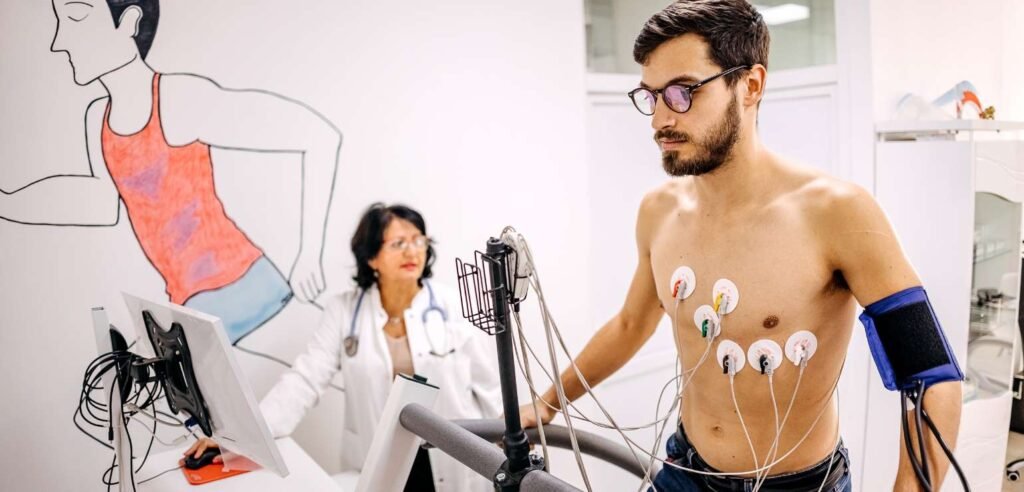
A TMT (Treadmill Test) — also called an exercise stress test or stress ECG — monitors the heart’s electrical activity while the patient walks on a treadmill at progressively increasing speeds and inclines. ECG electrodes are attached to the chest, and blood pressure is measured at regular intervals throughout the test.
The logic behind the test is straightforward: many heart problems — particularly coronary artery disease — do not cause symptoms or abnormalities on a resting ECG. When the heart is put under physical demand, narrowed coronary arteries cannot supply enough blood, and this reveals itself as characteristic ECG changes, symptoms like chest pain or breathlessness, or an abnormal blood pressure response. The TMT brings out what the resting tests cannot show.
What a TMT Is Looking For
• ST segment changes on the ECG during exercise — the most important indicator of reduced blood supply (ischaemia) to the heart muscle
• Chest pain, breathlessness, or dizziness during exercise that correlates with ECG changes
• Abnormal heart rate response — failure to reach target heart rate, or abnormal slowing
• Blood pressure response — an abnormal drop in blood pressure during exercise is a significant finding
• Arrhythmias triggered by exercise — abnormal heart rhythms that appear only during physical activity
Who Typically Needs a TMT
• Patients with chest pain or tightness that comes on with exertion and settles with rest — the classic description of angina
• Patients with risk factors for coronary artery disease — diabetes, hypertension, high cholesterol, smoking, family history — who want a baseline cardiac assessment
• Patients who have been treated for coronary artery disease — to assess the effectiveness of treatment
• Patients cleared for high-intensity exercise or physically demanding occupations
• Patients with palpitations that occur specifically during exercise
Can You Have Both Tests on the Same Day?
Yes, and at Sonobeat Heart Care, both a 2D echo and a TMT stress test can be performed on the same visit. In fact, a stress echocardiogram — where echo images are taken immediately before and after the TMT — combines the functional information of both tests and is one of the most informative cardiac evaluations available for detecting coronary artery disease.
Which Test Does Your Cardiologist Recommend and Why
Dr. Kuldeep Totawar typically recommends a 2D echo first when the concern is about the structure and pumping function of the heart — valve disease, heart failure, cardiomyopathy, or assessment after a heart attack. A TMT is recommended when the primary concern is whether the coronary arteries are adequately supplying the heart during activity — particularly for patients with exertional chest symptoms or multiple cardiac risk factors.
Many patients with existing heart disease or multiple risk factors benefit from both — the echo providing the structural baseline and the TMT providing the functional stress assessment. Your cardiologist will advise which combination is most appropriate for your specific clinical situation.
Frequently Asked Questions
Q: Is the TMT test safe? What if my heart reacts badly during the test?
TMT is performed in a medically supervised environment with a cardiologist and a resuscitation team present. The test is stopped immediately if significant ECG changes, chest pain, or abnormal blood pressure responses occur. Serious complications during a supervised TMT are extremely rare. The test is safe for the vast majority of patients for whom it is recommended.
Q: Do I need to stop any medications before a 2D echo or TMT?
For a 2D echo, no special preparation is needed. For a TMT, certain medications — particularly beta blockers — may affect the heart rate response and your cardiologist may advise stopping them 24 to 48 hours before the test. Always check with your doctor before stopping any cardiac medication.
Q: How long does it take to get results?
At Sonobeat Heart Care, 2D echo results are typically discussed with you on the same day. TMT results are also available immediately after the test. A written report is provided, and Dr. Kuldeep Totawar reviews the findings with you in the follow-up consultation.
Not Sure Which Heart Test You Need? Let Us Guide You.
Dr. Kuldeep Totawar at Sonobeat Heart Care will assess your symptoms and recommend the right cardiac evaluation for your specific situation.
Visit sonobeatcare.com or find us on Google to book your appointment today.
Have heart concerns? Book An Appointmentat Sonobeat Heart Care today.
Google: Sonobeat Heart Care on Google | 2D Echo: 2D Echo in Aurangabad | TMT Test: TMT Stress Test